The gap between estimated vs real power is not a fixed percentage that can be quoted once. It depends almost entirely on terrain, because an estimate has to guess the quantities a meter never needs to know. On a steep climb those guesses barely matter. On a flat road they decide the answer.
What a power meter measures and an estimate cannot
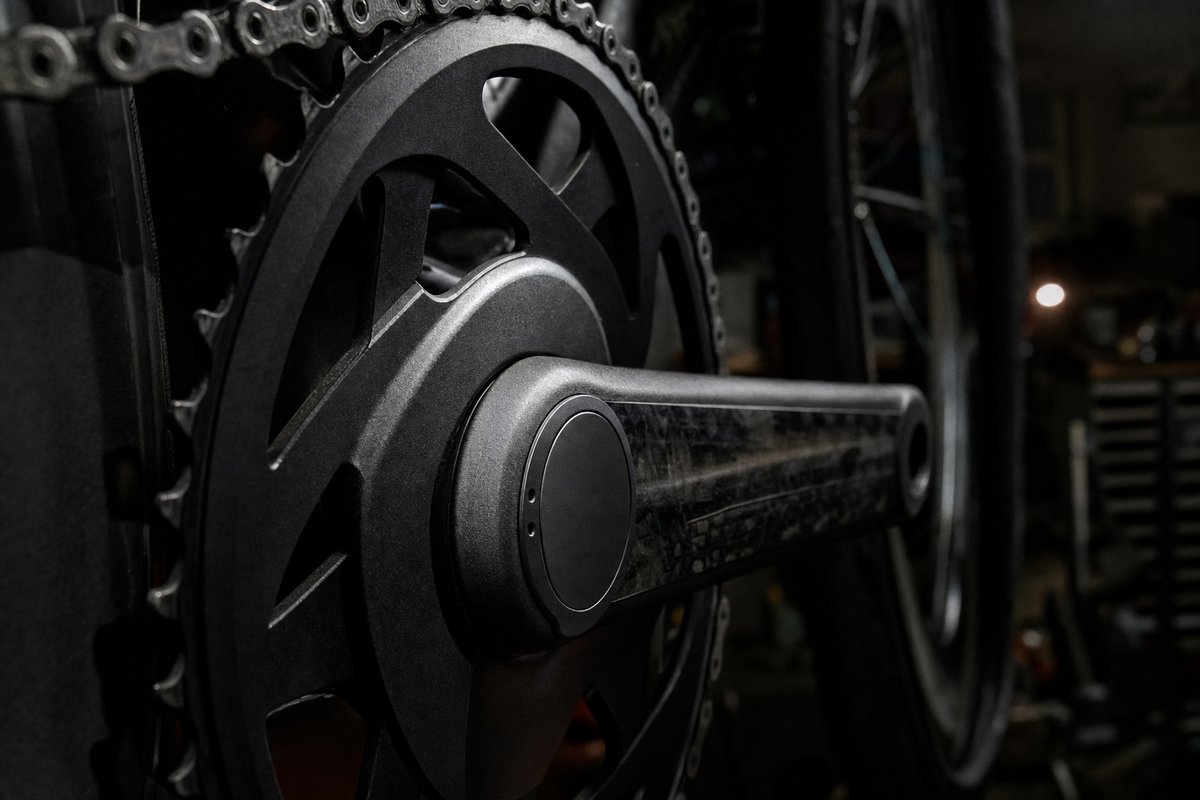
A power meter measures force and rotational speed at one point in the drivetrain and multiplies the two together. It needs no assumption about air, tyres, road surface or riding position, because it observes the work directly. Its errors are small, systematic and almost always about calibration, not about the world it is describing.
An estimate works backwards from the outcome instead. It takes speed, gradient and mass, assumes a drag area, a rolling resistance coefficient and an air density, then computes the power those conditions would have demanded. Every one of those assumptions is a guess, and each guess enters the answer as error.
The three assumptions that carry the error
Drag area is by some distance the largest of the three. A rider on the hoods and the same rider in the drops differ by perhaps twenty percent in frontal area, which at speed is a very large difference in watts. No estimate can see which position was used, and riders change position constantly.
Rolling resistance varies with tyre, pressure and surface by a factor of two or more between a fast tyre on smooth tarmac and a touring tyre on a rough lane. Air density varies with both altitude and temperature, which on a mountain in summer departs substantially from the sea-level default.
Where estimated cycling wattage is actually trustworthy
On a sustained climb above roughly six percent, the gravitational term dominates so heavily that the other two collapse into rounding errors. Lifting eighty kilograms a thousand vertical metres takes a fixed amount of energy no matter what tyres are fitted or how the rider sits, and the estimate converges on the truth.
This is why outside analysis of cycling performance concentrates almost entirely on climbing, and why the same approach applied to a flat time trial produces numbers that nobody should rely on. The method is not uniformly good or bad; it is conditional, and the condition that governs it is gradient.
| Terrain | Dominant term | Plausible error |
|---|---|---|
| Climb above 8 percent | Gravity | A few percent |
| Climb of 4 to 8 percent | Gravity, some aerodynamics | Around five to ten percent |
| Rolling terrain | Mixed | Ten to twenty percent |
| Flat road | Aerodynamics | Twenty percent or more |
| Any descent | Aerodynamics, braking | Not meaningful |
Using an estimate without overstating it
Quote a band, not a single figure. Saying a climb required somewhere between 5.9 and 6.3 watts per kilogram is both defensible and useful. Saying it required exactly 6.1 implies a precision the method does not have, and invites an argument about the second decimal place that cannot be won.
State the assumptions plainly alongside the result. An estimate whose inputs are visible can be challenged on those inputs, which is exactly how it should work. An estimate presented as a bare number cannot be examined at all, and a number that cannot be examined is not evidence of anything.
Power estimation questions
How close is estimated power to a meter on a climb?
On a steep sustained climb, typically within a few percent, because gravity accounts for nearly all the work and gravity is the one term that needs no guessing. The steeper and longer the climb, the tighter the agreement between the two methods becomes. Below about four percent they separate quickly, and on the flat they stop being comparable.
Why is estimated wattage useless on the flat?
Because air resistance dominates and depends on a drag area nobody can observe from outside. Position, clothing, equipment and even a following rider change it substantially. The estimate becomes a statement about the assumed drag figure rather than about the athlete. Two defensible drag assumptions can move the answer by fifty watts on the same ride.
Does wind ruin an estimate?
On flat ground, completely. On a steep climb the speeds are low enough that aerodynamic effects are small, so wind matters far less than intuition suggests. A headwind on a twenty percent gradient at eight kilometres per hour barely registers in the total. The same wind on a flat time trial can account for a fifth of the power required.
Can an estimate detect a motor?
Not directly. It can establish that the power required exceeded what the rider could plausibly supply, which is a different and weaker claim. Distinguishing assistance from a recording error, a wrong weight or an exceptional athlete is not something arithmetic alone can do. That is a limit of the method, not a gap a better model will close.
Is a smart trainer's power the same as a meter's?
Close but not identical. A trainer measures at the wheel or estimates from its own resistance curve, so drivetrain losses and calibration drift place it slightly differently from a crank or pedal meter. Consistency within one device matters more than agreement between two. Compare a trainer against itself over weeks, and never against a crank meter within a single session.
Related: the plausibility check applies this model to a public result, the watts per kg calculator handles a known figure, and VAM avoids the aerodynamic guess altogether.